How to Check If Your Property Has an Article 4 Direction
Three ways to find out whether an Article 4 direction applies to your property, what rights it removes, and what it means for home improvements.
Checking a specific address?
Skip the theory — put the address in and see every constraint recorded against it in the datasets we check, free.
Postcode, address, grid reference or UPRN. England, Wales and Scotland, free, no signup.
An Article 4 direction is one of those planning constraints that can catch homeowners off guard. It removes specific permitted development rights, meaning works you'd normally be free to do — like changing your windows, painting your house, or building a small extension — suddenly require planning permission.
Here's how to find out if one applies to your property.
Method 1: Use our free planning constraints tool
The Planning Constraints Map shows Article 4 directions from planning.data.gov.uk.
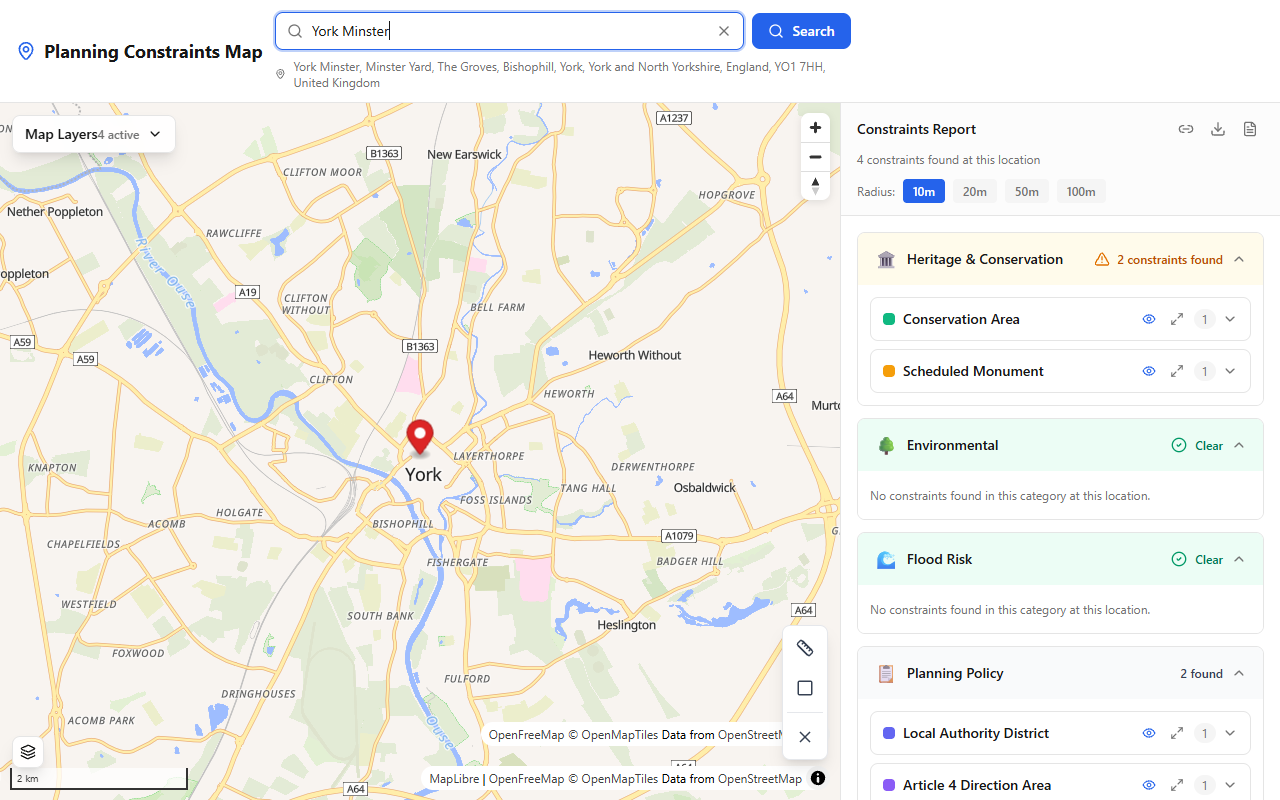
Article 4 Direction area found in York, alongside conservation area and local authority data.
- Open the Planning Constraints Map
- Search for your postcode or address
- Check the results panel for Article 4 direction entries
- The affected area is highlighted on the map
The tool shows which Article 4 directions apply, though the specific rights that have been removed may vary — for the exact details of what's restricted, you'll need to check with the council (see Method 2).
Method 2: Check your council's planning pages
Your local planning authority will have published details of all Article 4 directions in its area. Search for "[your council name] Article 4 direction" to find:
- A list of current Article 4 directions
- Maps showing the areas they cover
- Details of exactly which permitted development rights are removed
This is the most comprehensive source because it tells you precisely which classes of permitted development are affected. An Article 4 direction on a conservation area street might only remove the right to change windows and doors, while one on an HMO conversion hotspot might remove the right to convert dwellings to houses in multiple occupation.
Method 3: Local Authority Search
The CON29 Local Authority Search during conveyancing will flag any Article 4 directions affecting a property. This is part of the standard property purchase process.
What is an Article 4 direction?
Normally, homeowners have "permitted development rights" under the Town and Country Planning (General Permitted Development) (England) Order 2015. These allow certain works without needing to apply for planning permission — small extensions, loft conversions, changing windows, and so on.
An Article 4 direction is a legal order made by the local planning authority that removes one or more of these permitted development rights for a defined area. Once an Article 4 direction is in place, you need to apply for planning permission for the works that have been removed — even though identical works on a property without the direction would be allowed freely.
Where are Article 4 directions commonly found?
Conservation areas
The most common use. Councils apply Article 4 directions to conservation areas to control changes like:
- Replacing timber windows with uPVC
- Changing front doors
- Altering or removing boundary walls and railings
- Painting or rendering external walls
- Changing roofing materials
- Installing satellite dishes
The aim is to protect the character of the conservation area from gradual erosion through small, individually minor changes that cumulatively degrade the streetscape.
HMO conversion areas
In areas with high concentrations of houses in multiple occupation (HMOs), councils sometimes use Article 4 directions to remove the right to convert a dwelling (Use Class C3) to a small HMO (Use Class C4) without planning permission. This is common in university cities and towns.
Employment areas
Some councils use Article 4 directions to prevent the conversion of office buildings to residential use under permitted development rights, protecting commercial areas from losing employment space.
What happens if an Article 4 applies?
You'll need to submit a planning application for the work that would otherwise have been permitted development. The good news:
- No application fee — planning applications for work that would have been permitted development but for an Article 4 direction are free
- Standard assessment — the council assesses the application on its merits, just like any other planning application
- Not a presumption against — the council can't refuse just because an Article 4 direction exists. They still need a valid planning reason to refuse
In practice, most reasonable proposals are approved. The Article 4 direction simply gives the council the opportunity to assess the work and, if necessary, attach conditions (such as requiring a specific material or finish).
Summary
Three ways to check for an Article 4 direction:
- Quickest — Use the Planning Constraints Map to see if one applies to your area
- Most detail — Check your council's website for the specific rights that have been removed
- During purchase — The Local Authority Search identifies Article 4 directions
An Article 4 direction doesn't prevent work — it just means you need planning permission for things that would otherwise be free to do. Applications are free and most reasonable proposals are approved.
Survey your own site — free
Screen any address in England, Wales or Scotland in seconds: conservation areas, listed buildings, flood risk, Article 4 and 129 more. Need it on paper? The Full Survey Report with plain-English guidance is £9.99.