How to Check If a Property Is in a Conservation Area
Three quick ways to find out whether a house or piece of land falls within a conservation area in England, and what it means for your plans.
Checking a specific address?
Skip the theory — put the address in and see every constraint recorded against it in the datasets we check, free.
Postcode, address, grid reference or UPRN. England, Wales and Scotland, free, no signup.
Whether you're buying a house, planning an extension, or thinking about replacing your windows, one of the first things you should check is whether the property is in a conservation area. Around 10,000 conservation areas cover parts of nearly every town and city in England, and the designation affects what you can do without planning permission.
Here are three ways to find out.
Method 1: Use our free planning constraints tool
The fastest way to check is the Planning Constraints Map. It uses official data from planning.data.gov.uk to show conservation area boundaries across England, and the equivalent designations from Cadw in Wales and Historic Environment Scotland in Scotland.
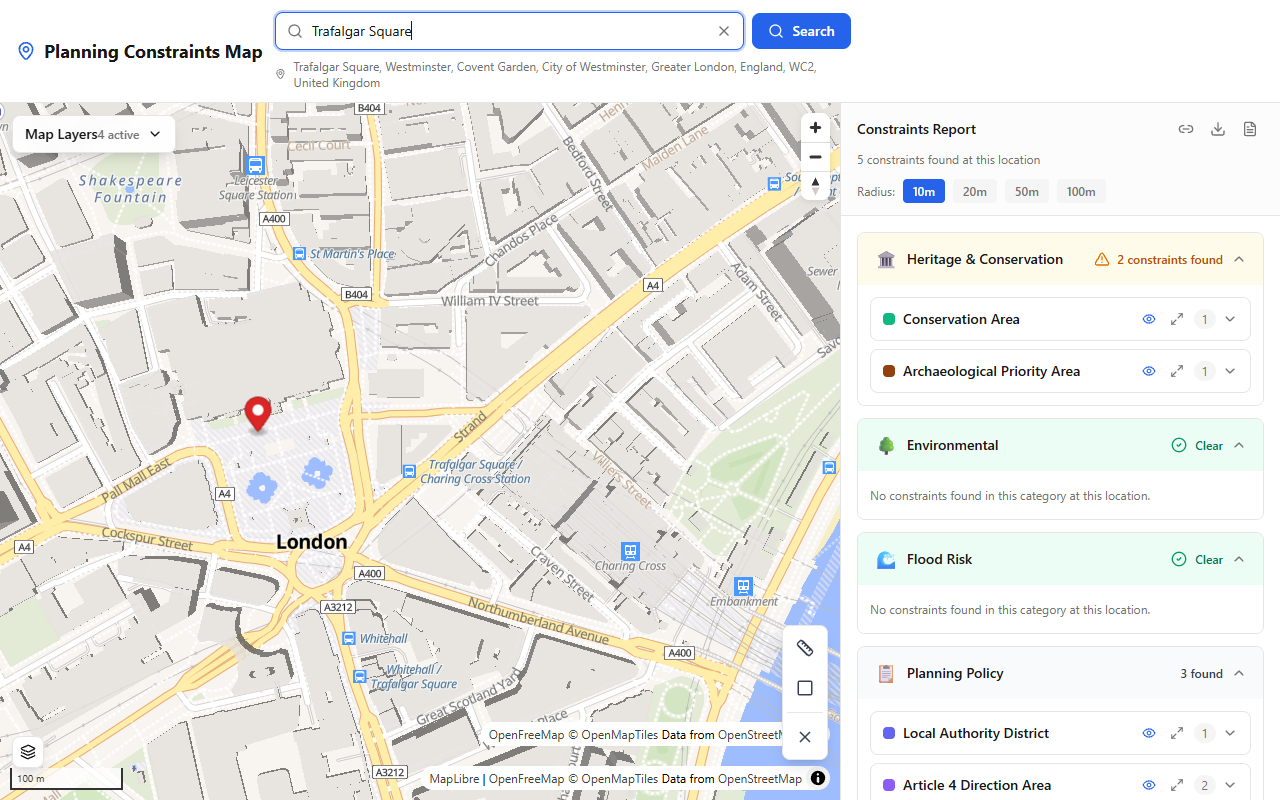
Conservation area boundary highlighted on the map in Richmond, London, with the constraints panel showing heritage results.
- Open the Planning Constraints Map
- Type the postcode or address into the search box
- The results panel shows whether the location falls inside a conservation area
- The boundary is drawn on the map so you can see exactly where the designation starts and ends
This takes seconds and covers every conservation area that has been published to the national dataset. It also shows you every other planning constraint at the same location — flood zones, listed buildings, green belt, and more.
Method 2: Check your council's website
Every local planning authority maintains records of its conservation areas. Search for "[your council name] conservation areas" and you'll usually find:
- A map showing all conservation area boundaries
- A list of conservation areas with dates of designation
- Conservation Area Character Appraisals — detailed documents describing what makes each area special
The council's map is the definitive source, particularly if you need an official answer. Some councils have interactive online maps; others publish PDF maps that can be harder to navigate.
One advantage of checking the council is that you may also find information about permitted development restrictions and any Article 4 directions that apply within the conservation area.
Method 3: Property search during conveyancing
If you're buying a property, your solicitor will order a Local Authority Search (CON29) as part of the conveyancing process. This is a formal written response from the council confirming which planning designations apply to the property.
The search covers conservation areas, listed buildings, tree preservation orders, and other constraints. It typically costs between £100 and £300 and can take several weeks, so it's not suitable for quick checks — but it provides an official, legally relied-upon answer.
What does it mean if your property is in a conservation area?
Conservation areas are designated to protect the character and appearance of places with special architectural or historic interest. If your property is in one, the main practical effects are:
Reduced permitted development rights
Some works that would normally be allowed without planning permission require an application in a conservation area:
- Cladding, rendering, or changing external materials
- Side extensions (single-storey)
- Roof alterations visible from a highway
- Satellite dishes facing a highway
- Larger rear extensions under prior approval
Demolition control
You need planning permission to demolish any building in a conservation area, including walls and boundary features above a certain height. Outside a conservation area, most demolition doesn't require consent.
Tree protection
All trees in a conservation area with a trunk diameter of 75 mm or more (at 1.5 m height) are automatically protected. You must give the council six weeks' notice before doing any work on them.
Higher design standards
Planning applications are assessed against the need to preserve or enhance the character of the conservation area. Materials, scale, and design details all receive greater scrutiny.
Article 4 directions
Some conservation areas have additional restrictions through Article 4 directions, which remove further permitted development rights — for example, requiring planning permission to change windows from timber to uPVC or to paint the exterior of a house.
What if you're not sure about the boundaries?
Conservation area boundaries can be precise — sometimes the line runs through the middle of a street, with one side inside and the other outside. If your property is close to the edge, it's worth checking carefully. Our map tool shows the exact boundary data, or you can ask your council's conservation officer to confirm.
Summary
Checking whether a property is in a conservation area is straightforward:
- Quickest — Use the Planning Constraints Map for an instant answer from official data
- Most detail — Check your council's conservation area pages for character appraisals and specific policies
- Most formal — A Local Authority Search during conveyancing provides a legally relied-upon confirmation
If you are in a conservation area, the key things to know are that some permitted development rights are restricted, demolition needs consent, trees are protected, and design standards are higher. None of this prevents you from making changes — it just means some works need an application that wouldn't otherwise.
Survey your own site — free
Screen any address in England, Wales or Scotland in seconds: conservation areas, listed buildings, flood risk, Article 4 and 129 more. Need it on paper? The Full Survey Report with plain-English guidance is £9.99.