How to Check If a Building Is Listed
Three ways to find out whether a house or building is listed, what the grades mean, and what you need to know before making any changes.
Checking a specific address?
Skip the theory — put the address in and see every constraint recorded against it in the datasets we check, free.
Postcode, address, grid reference or UPRN. England, Wales and Scotland, free, no signup.
If you're buying an older property, planning renovation work, or just curious, it's worth checking whether the building is listed. Listed building status is one of the most significant planning constraints a property can have — you need special consent for almost any alteration, inside or out.
Here's how to check.
Method 1: Use our free planning constraints tool
The Planning Constraints Map shows listed buildings from Historic England data. It displays all listed buildings near your searched location, along with their grade.
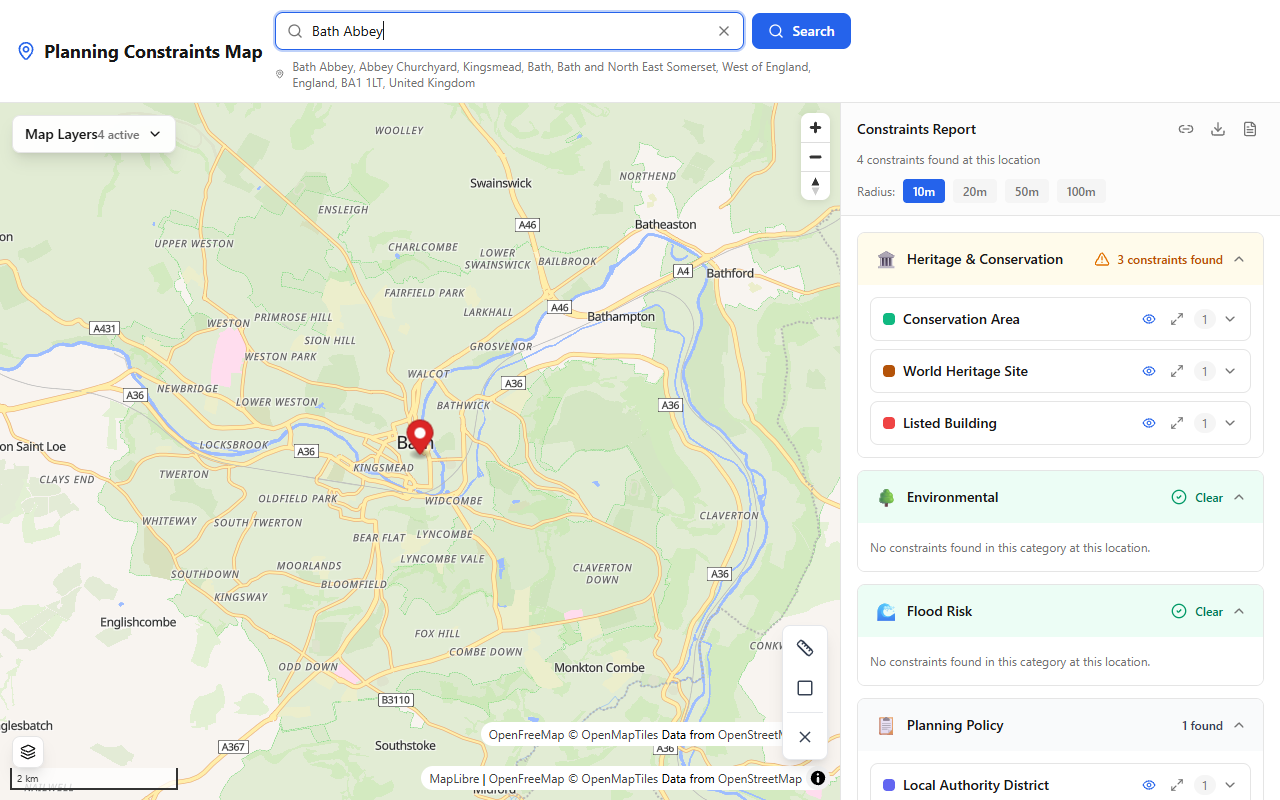
The Planning Constraints Map showing heritage results in Bath, including World Heritage Site and Scheduled Monument alongside listed building data.
- Open the Planning Constraints Map
- Search for the address or postcode
- Check the results panel for listed building entries
- Listed buildings appear as markers on the map with their grade shown
The tool checks the entire National Heritage List for England, so it covers Grade I, Grade II*, and Grade II buildings.
Method 2: Search the National Heritage List
Historic England maintains the official National Heritage List for England. You can search by:
- Address or postcode
- Building name
- List entry number (if you have it)
- Map location
Each list entry includes the building's grade, the date it was listed, a description of its special interest, and a map showing its exact location. This is the definitive source.
Method 3: Local Authority Search
During conveyancing, the Local Authority Search (CON29) will confirm whether a property is a listed building. Your solicitor handles this as part of the standard property purchase process.
What do the grades mean?
There are three grades of listing in England:
- Grade I — Buildings of exceptional interest (about 2% of all listed buildings). Examples: cathedrals, major country houses, the Palace of Westminster.
- Grade II* — Particularly important buildings of more than special interest (about 5.8%). Examples: significant churches, notable civic buildings.
- Grade II — Buildings of special interest (about 92%). This covers the vast majority — Georgian townhouses, Victorian villas, farmhouses, pubs, walls, and street furniture.
The grade affects the level of scrutiny but the legal requirements are the same for all grades: you need Listed Building Consent for works affecting the building's character.
What does listing mean in practice?
You need Listed Building Consent
Listed Building Consent (LBC) is required for any works that affect the character of the building. This includes:
- Internal changes — removing or altering walls, staircases, fireplaces, panelling, or other historic features
- External changes — replacing windows or doors, changing roofing materials, adding render or cladding
- Extensions — any addition to the building
- Demolition — total or partial
LBC is separate from planning permission. For many projects you'll need both.
The whole building is protected
Listing covers the entire structure — not just the front facade or the parts visible from the road. Internal features, rear elevations, outbuildings within the curtilage (if built before 1 July 1948), and fixtures are all included.
The setting matters too
Development on neighbouring land that would affect the setting of a listed building can be refused on heritage grounds, even if the listed building itself isn't being touched.
It's a criminal offence to do works without consent
Carrying out unauthorised work to a listed building is a criminal offence under Section 9 of the Planning (Listed Buildings and Conservation Areas) Act 1990. Penalties include fines and a requirement to reverse the work.
Common questions
Can I replace the windows?
You'll need LBC. Most councils expect like-for-like replacement in matching materials (usually timber). Secondary glazing (an additional internal pane) is often more acceptable than replacing original windows with double-glazed units. Each case is judged on its merits.
Can I add an extension?
Yes, with LBC and usually planning permission. The extension needs to be sympathetic to the character of the listed building in terms of design, materials, and scale.
Can I do minor maintenance?
Genuine like-for-like repairs using matching materials generally don't need LBC. Replacing a broken roof tile with an identical one, or repointing brickwork with matching mortar, is usually fine. But if you're changing materials or methods, check first.
Can I get a building de-listed?
Technically yes, but it's rare. You can apply to Historic England, but the building would need to have lost its special interest — for example, through severe alteration. The bar is high.
Tips for listed building owners
- Contact your council's conservation officer early — they can give informal advice on what's likely to be acceptable before you spend money on formal applications
- Read the list entry — Historic England's description tells you what's considered special about the building, which helps you understand what the council will want to protect
- Budget for traditional materials — listed building work often costs more because of the requirement to use traditional materials and techniques
- Get specialist help — a heritage consultant or architect experienced with listed buildings can help design proposals that are more likely to gain consent
Summary
Three ways to check if a building is listed:
- Quickest — Use the Planning Constraints Map to see listed buildings near any location
- Most detail — Search the National Heritage List for England
- During purchase — The Local Authority Search confirms listing status
If a building is listed, you need Listed Building Consent for most alterations. This doesn't prevent change — it ensures changes are sympathetic to the building's special interest.
Survey your own site — free
Screen any address in England, Wales or Scotland in seconds: conservation areas, listed buildings, flood risk, Article 4 and 129 more. Need it on paper? The Full Survey Report with plain-English guidance is £9.99.