How to Find Out If You Live Near a Scheduled Monument
Three ways to check for scheduled monuments near your property, what scheduling means, and how it affects development in the surrounding area.
Checking a specific address?
Skip the theory — put the address in and see every constraint recorded against it in the datasets we check, free.
Postcode, address, grid reference or UPRN. England, Wales and Scotland, free, no signup.
Scheduled monuments are nationally important archaeological sites and historic structures protected by law. If one is on or near your property, it can significantly affect what development is possible. There are around 20,000 scheduled monuments in England, ranging from Roman forts and medieval castles to Bronze Age barrows and industrial-era structures.
Here's how to check.
Method 1: Use our free planning constraints tool
The Planning Constraints Map shows scheduled monuments from Historic England data.
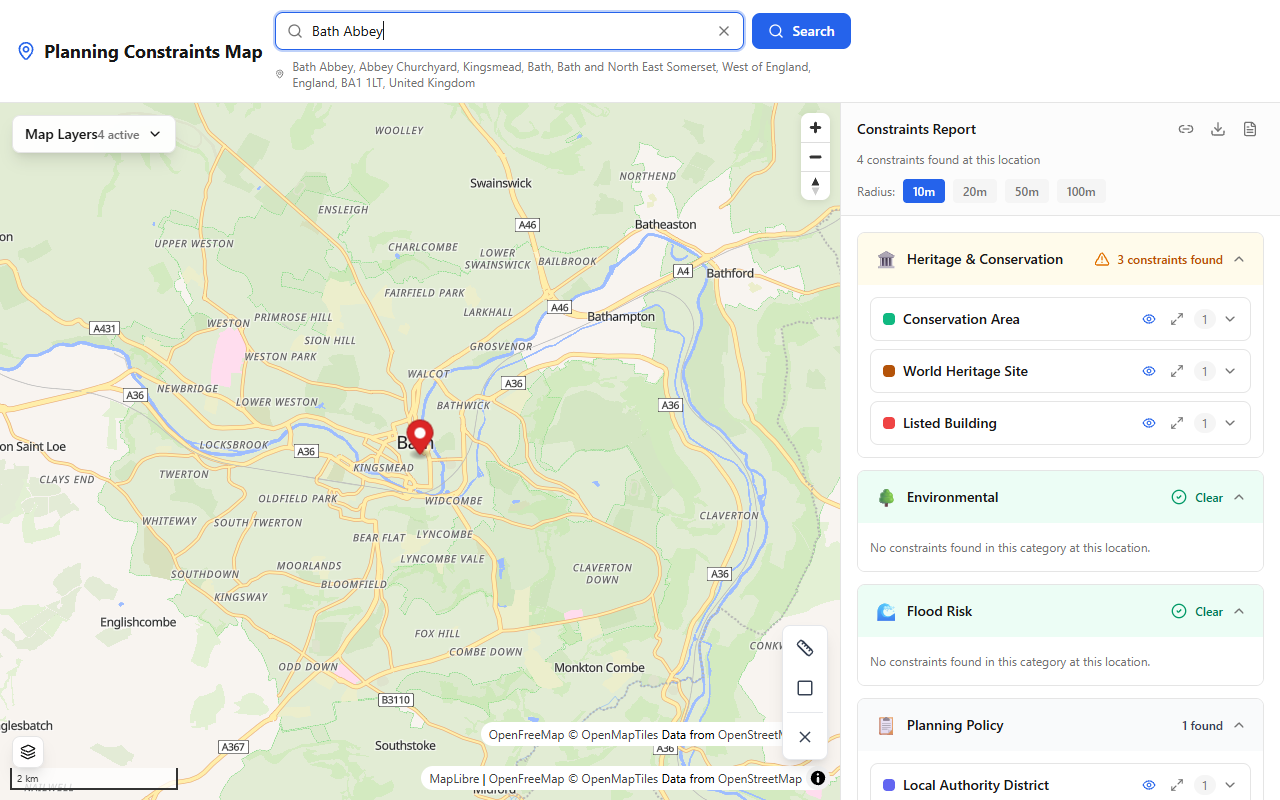
Bath city centre showing a Scheduled Monument, Conservation Area, and World Heritage Site in the constraints panel.
- Open the Planning Constraints Map
- Search for your postcode or address
- Check the results panel for scheduled monument entries
- Monument locations and extents appear on the map
The tool shows all scheduled monuments near your searched location, not just those on the exact property.
Method 2: Search the National Heritage List
Historic England's National Heritage List for England includes all scheduled monuments alongside listed buildings. You can search by location, name, or reference number to find details of any monuments in the area.
Each entry includes a description, the scheduling date, and a map showing the monument's extent (the protected area, which often extends beyond the visible remains).
Method 3: Local Authority Search
The Local Authority Search (CON29) during conveyancing will identify scheduled monuments affecting a property. Historic England is also consulted on planning applications that might affect the setting of scheduled monuments.
What is a scheduled monument?
Scheduling is the oldest form of heritage protection in England, dating back to the Ancient Monuments Protection Act 1882. A scheduled monument is a site of national importance that has been placed on the Schedule of Monuments maintained by the Secretary of State, acting on the advice of Historic England.
Scheduled monuments cover a wide range:
- Prehistoric sites — stone circles, burial mounds, hillforts, field systems
- Roman remains — forts, roads, villas, bath houses
- Medieval structures — castles, moated sites, abbeys, village earthworks
- Post-medieval and industrial — blast furnaces, lime kilns, colliery remains
- Military — defensive structures, pillboxes, Cold War bunkers
Many scheduled monuments are below ground — you may not be able to see them from the surface. The protected area (the "scheduled area") is defined on a map and can cover a significant extent around the visible remains.
How scheduling affects your property
Scheduled Monument Consent
If a monument is on your land, you need Scheduled Monument Consent (SMC) from the Secretary of State (administered by Historic England) for any works that would affect it. This includes:
- Any ground disturbance within the scheduled area (digging, ploughing below a certain depth, laying foundations)
- Demolition, destruction, damage, or removal of the monument or any part of it
- Flooding or tipping on the site
- Repair, alteration, or addition to the monument
SMC is separate from planning permission. You may need both.
The penalties for unauthorised works to a scheduled monument are severe — unlimited fines and up to two years' imprisonment.
The setting of scheduled monuments
Even if the monument isn't on your land, its setting is a material consideration in planning decisions. Development near a scheduled monument that would harm its significance or setting can be refused.
This is particularly relevant if you're planning:
- New buildings within the sight lines of a monument
- Development that would change the character of the surrounding landscape
- Works that might affect below-ground archaeology connected to the monument
Archaeological assessments
If you're applying for planning permission near a scheduled monument, the council may require an archaeological assessment or evaluation (such as a desk-based assessment or trial trenching) to understand the potential impact on buried remains.
What if you find archaeology during building work?
If you discover archaeological remains during construction or groundwork, you should stop work and contact your council's archaeological officer. While there's no automatic legal requirement to stop (unless the site is scheduled), councils typically attach conditions to planning permissions requiring archaeological recording of any finds.
Deliberately destroying archaeological remains that you know about can have legal and planning consequences.
Summary
Three ways to check for scheduled monuments:
- Quickest — Use the Planning Constraints Map for instant results from Historic England data
- Most detail — Search the National Heritage List for England
- During purchase — The Local Authority Search identifies scheduled monuments
If a scheduled monument is on your land, you need Scheduled Monument Consent for any works. Even if it's nearby, the monument's setting can affect planning decisions for your property.
Survey your own site — free
Screen any address in England, Wales or Scotland in seconds: conservation areas, listed buildings, flood risk, Article 4 and 129 more. Need it on paper? The Full Survey Report with plain-English guidance is £9.99.