How to Find Planning Constraints Before Buying a House
A practical guide to checking planning constraints before you buy a property, so you know exactly what restrictions apply and avoid costly surprises.
Checking a specific address?
Skip the theory — put the address in and see every constraint recorded against it in the datasets we check, free.
Postcode, address, grid reference or UPRN. England, Wales and Scotland, free, no signup.
When you're buying a house, it's easy to focus on the kitchen, the garden, and the local schools. But planning constraints — the legal designations and policies that control what you can do with a property — can have a bigger impact on your long-term plans than any of those things.
A conservation area might stop you replacing the windows with double glazing. A flood zone could push up your insurance costs. Green belt might prevent the extension you had in mind. And a Tree Preservation Order could mean that overgrown tree in the garden is staying put.
Here's how to check planning constraints before you commit to a purchase.
Step 1: Run a free online check
Before you even book a viewing, you can get a comprehensive picture of planning constraints for any property in England, Wales or Scotland using the Planning Constraints Map.
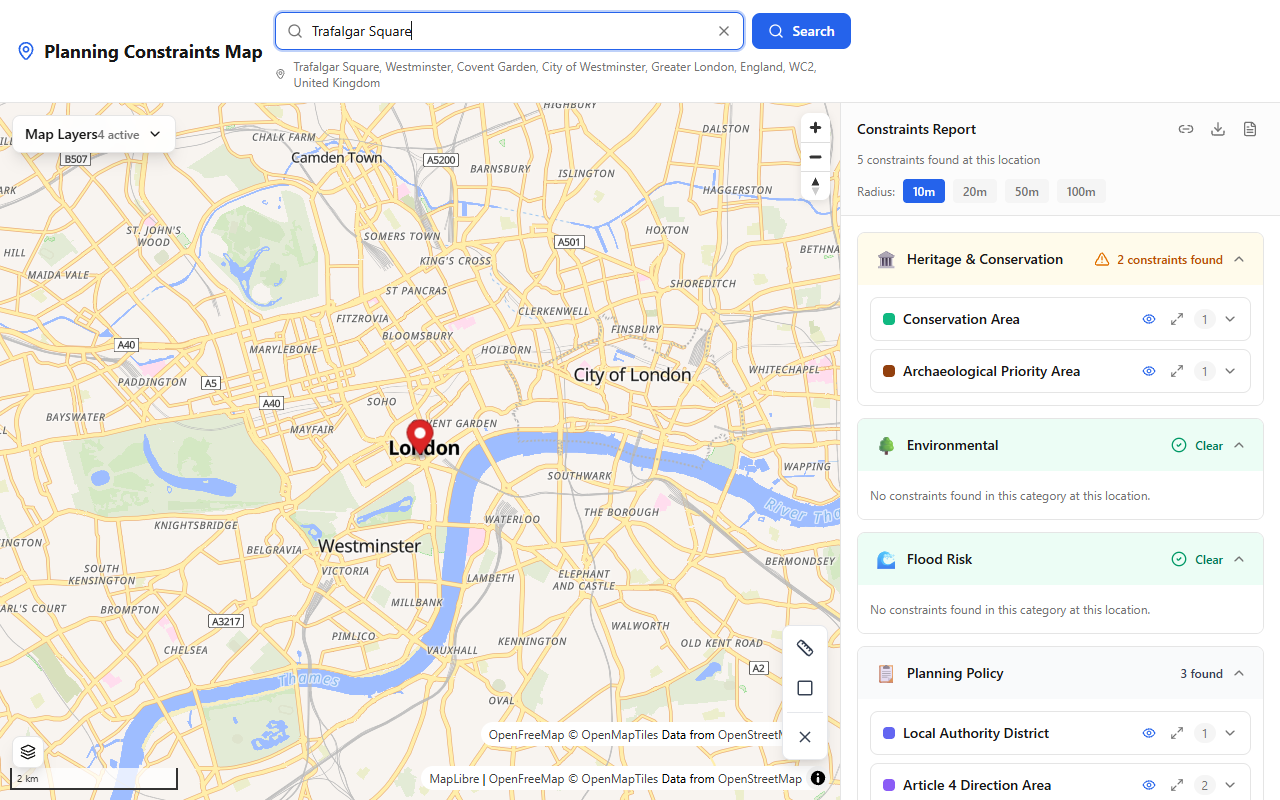
Instantly see all planning constraints near any address in England, Wales or Scotland — conservation areas, flood zones, heritage designations and more.
- Open the tool
- Type in the postcode or address
- Review every planning constraint within 50 metres — with the nearest constraint beyond that named too (wider radii are part of the Site Report Pass)
In seconds, you'll see whether the property is affected by:
- Conservation areas
- Listed building status
- Flood zones (2 and 3)
- Green belt
- Tree preservation orders
- Areas of Outstanding Natural Beauty
- SSSIs and other environmental designations
- Article 4 directions
- Scheduled monuments
- And 20+ more constraint types
This gives you an immediate sense of what you're dealing with — before you've spent anything on surveys or solicitors.
Step 2: Understand what each constraint means
Not all constraints are problems. A conservation area might mean the street has great character — but it also means some permitted development rights are restricted. A flood zone might be manageable with the right insurance — but it affects your mortgage options.
Here's a quick reference:
| Constraint | Key impact |
|---|---|
| Conservation area | Some permitted development rights removed; demolition needs consent; trees protected; higher design standards |
| Listed building | Need Listed Building Consent for any alterations affecting character (interior and exterior) |
| Flood Zone 2 | Need Flood Risk Assessment for development; may affect insurance |
| Flood Zone 3 | Significant restrictions on new development; insurance likely more expensive; mortgage complications possible |
| Green belt | Strong presumption against new development; extensions must not be "disproportionate" |
| TPO | Cannot fell, prune, or damage protected trees without consent |
| AONB | Higher bar for development; some PD rights restricted; landscape impact carefully assessed |
| Article 4 direction | Specific permitted development rights removed — check which ones |
| SSSI | Development that could harm the SSSI is resisted; land management may be restricted |
| Scheduled monument | Need Scheduled Monument Consent for works; setting protected |
Step 3: Check the specific implications for your plans
If you're planning to extend, convert, or alter the property, match your plans against the constraints you've found:
Want to extend?
- Conservation area — check which PD rights are restricted; side extensions and larger rear extensions may need planning permission
- Green belt — extensions must not be disproportionate to the original building
- Listed building — you'll need Listed Building Consent as well as planning permission
- AONB — permitted development for larger extensions may not apply
Want to convert or change use?
- Article 4 direction — may remove the right to convert without planning permission
- Listed building — internal alterations need consent
- Conservation area — demolition (including internal structural changes) may need consent
Want to do garden or landscape work?
- TPO — protected trees cannot be touched without consent
- Conservation area — trees automatically protected
- SSSI — significant landscape changes near a SSSI may need assessment
Step 4: Check the Local Plan
Beyond the constraints themselves, the council's Local Plan sets out planning policies for the area. Check whether:
- The area is allocated for development (which could mean future construction nearby)
- There are specific design policies for the area
- The council has emerging plans that might change designations (e.g., a green belt review)
The Local Plan is available on your council's website. The Policies Map shows all designations spatially.
Step 5: Let your solicitor's searches confirm
When you make an offer and instruct a solicitor, they'll order formal searches including:
- Local Authority Search (CON29) — confirms planning designations, building control records, road schemes, and other matters affecting the property
- Environmental search — identifies flood risk, contaminated land, and environmental designations
- Drainage search — confirms water and sewerage connections and drainage risk
These searches provide formal, legally relied-upon confirmation of the constraints. But by this point, if you've done Steps 1–4, nothing should come as a surprise.
Red flags to watch for
Some combinations of constraints deserve particular attention:
- Flood Zone 3, or inside the climate change extent — check insurance availability and cost before committing
- Listed building + want to modernise — budget extra for traditional materials and specialist advice; some changes may not be possible
- Green belt + desire to extend significantly — the disproportionate additions test may limit what's achievable
- Multiple overlapping constraints — a property in a conservation area with listed status, TPOs, and an Article 4 direction will face cumulative restrictions
Summary
Checking planning constraints before buying a house protects you from costly surprises:
- Run a free check using the Planning Constraints Map to get the full picture instantly
- Understand what each constraint means for your specific plans
- Check the Local Plan for policies and future changes
- Confirm through your solicitor's formal searches during conveyancing
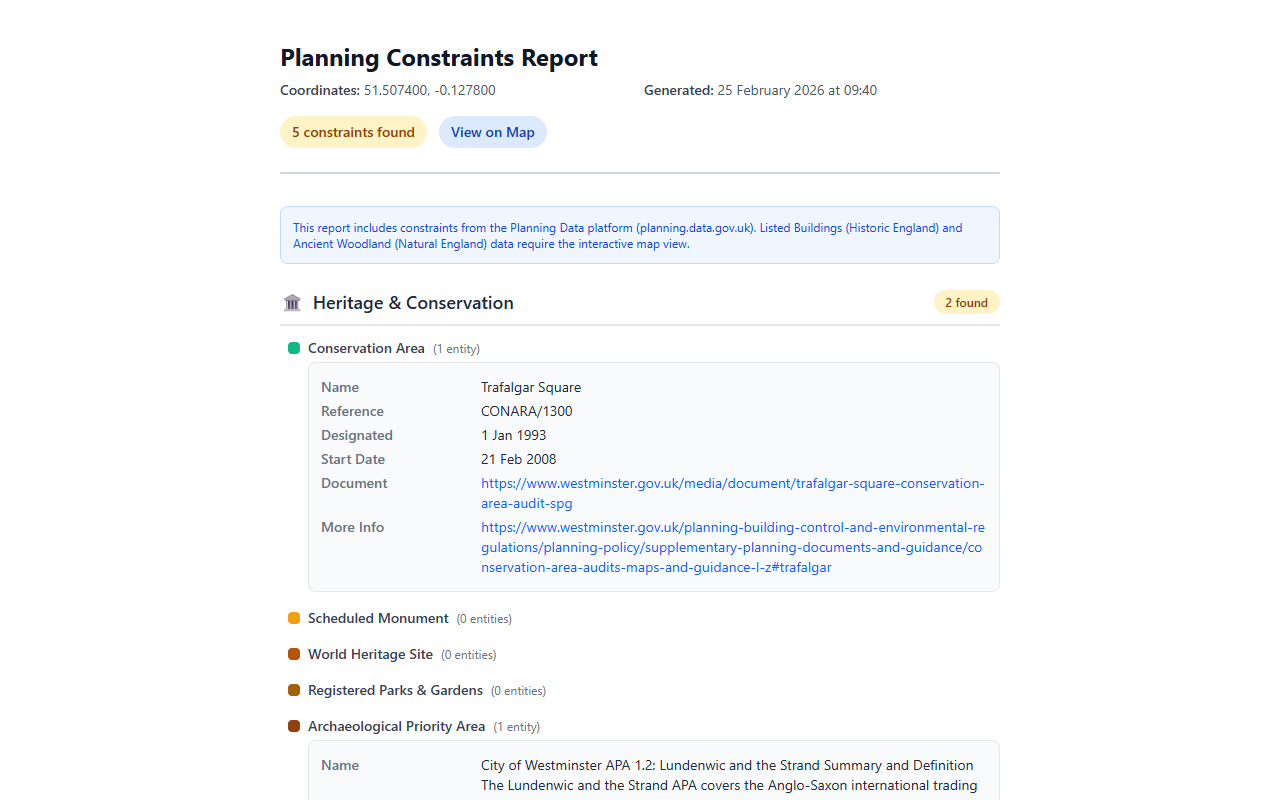
Generate a detailed planning constraints report showing all findings from official data sources.
The earlier you check, the better your position to negotiate the price, plan realistically, and avoid commitments you can't deliver on.
Survey your own site — free
Screen any address in England, Wales or Scotland in seconds: conservation areas, listed buildings, flood risk, Article 4 and 129 more. Need it on paper? The Full Survey Report with plain-English guidance is £9.99.