8 Planning Constraints That Could Block Your Extension
The most common planning constraints that affect home extensions in England — what each one means, and how to check whether they apply to your property using free open data.
Checking a specific address?
Skip the theory — put the address in and see every constraint recorded against it in the datasets we check, free.
Postcode, address, grid reference or UPRN. England, Wales and Scotland, free, no signup.
Before you call an architect — check what constraints apply to your property at PlanningConstraints.com. Enter your postcode and see instant results from official government data. Free, no sign-up.
Planning an extension? In many cases, you can extend a house without needing planning permission — this is called permitted development. But several planning constraints can remove or restrict those rights, meaning you will need a formal planning application even for relatively modest work.
Here are 8 constraints that could affect your extension plans, and how to check each one for free.
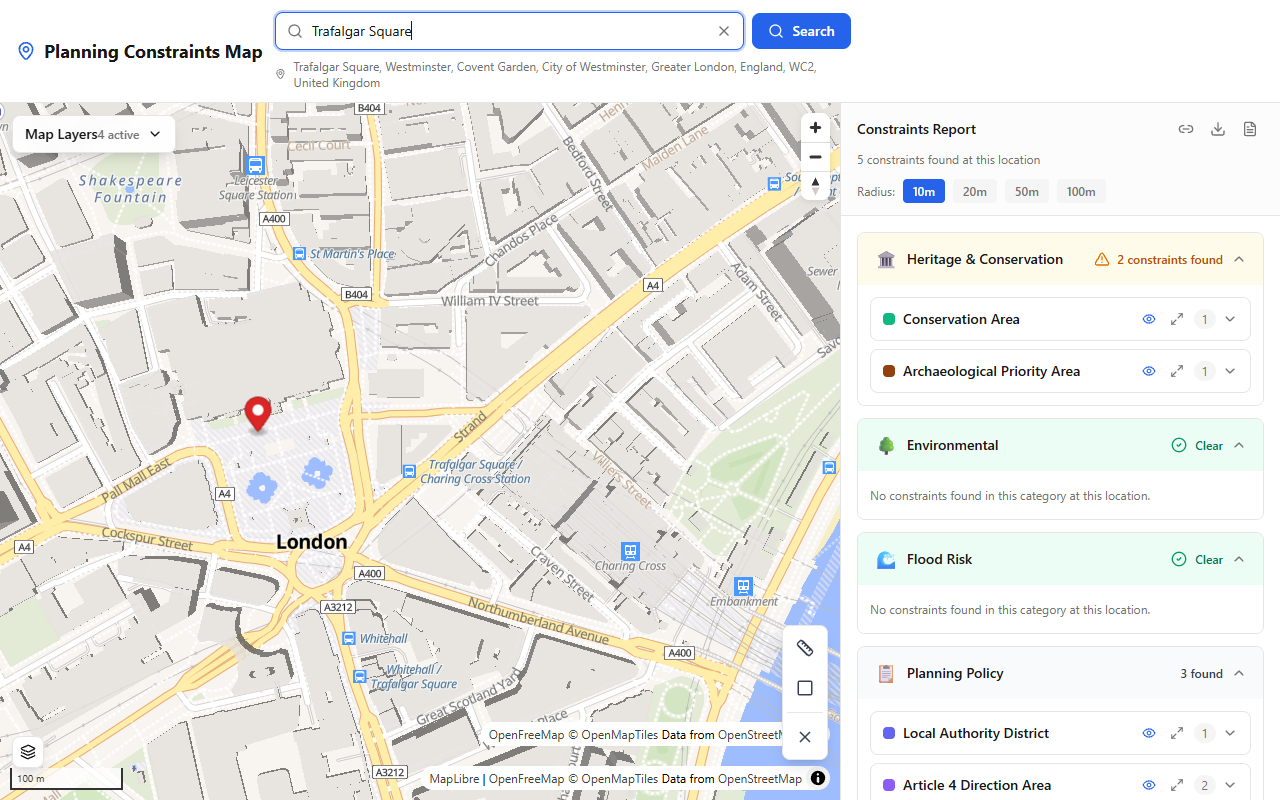
PlanningConstraints.com showing Conservation Area and other constraints — check your property in seconds before planning any work.
1. Conservation area
Impact on extensions: Permitted development rights are reduced in conservation areas. Side extensions, cladding, and any work involving demolition typically require planning permission. Rear extensions may still be allowed under permitted development but face tighter size limits. Design and materials will be scrutinised more closely.
How to check: Search your address on PlanningConstraints.com — conservation area status appears under Heritage & Conservation.
2. Listed building status
Impact on extensions: If your home is a listed building, you need listed building consent for any alteration — internal or external. This is in addition to any planning permission required. Even minor changes like replacing windows, moving a partition wall, or adding a satellite dish need consent.
How to check: PlanningConstraints.com flags listed buildings from Historic England data. You can also search the National Heritage List for England.
3. Article 4 direction
Impact on extensions: Article 4 directions remove specific permitted development rights in a defined area. The scope varies — some remove rights for extensions, others target changes of use or alterations to frontages. You need to check what the specific Article 4 direction covers for your property.
How to check: PlanningConstraints.com shows Article 4 directions under Planning Policy. For the full detail of what rights are removed, check your council's website.
4. Green belt
Impact on extensions: Extensions to existing buildings in the green belt may be acceptable provided they are "not disproportionate" compared to the size of the original building. What counts as disproportionate is a matter of judgement and varies between councils, but as a rule of thumb, increasing the original floor area by more than about a third is likely to be resisted.
How to check: PlanningConstraints.com shows green belt boundaries under Planning Policy.
5. Flood zone
Impact on extensions: An extension in Flood Zone 2 or 3 may require a flood risk assessment, and the design will need to incorporate flood resilience measures. Ground floor extensions in high-risk areas face extra requirements including raised floor levels, flood-resistant construction materials, and safe access/egress routes.
How to check: PlanningConstraints.com checks Environment Agency flood zone data automatically.
6. Tree preservation orders
Impact on extensions: If there is a tree with a TPO near your proposed extension, you cannot remove, prune, or damage it without the council's written consent. The tree's root protection area — a circle with a radius of roughly 12 times the trunk diameter — may restrict where you can dig foundations. This can make certain extension positions impractical.
How to check: PlanningConstraints.com checks TPO data from planning.data.gov.uk. For detailed information about specific trees, contact your council's tree officer.
7. AONB / National Landscape
Impact on extensions: Properties in an Area of Outstanding Natural Beauty (now called National Landscapes) have similar, though not identical, reduced permitted development rights to conservation areas. Extensions are more tightly controlled, and design quality is expected to reflect the character of the landscape.
How to check: PlanningConstraints.com includes AONB data from Natural England.
8. Scheduled monument
Impact on extensions: This is the rarest on the list but the most restrictive. If your property is on or adjacent to a scheduled monument, any ground works (including foundations for an extension) that could affect archaeological remains require scheduled monument consent from the Secretary of State. This is separate from planning permission and has its own application process.
How to check: PlanningConstraints.com flags scheduled monuments from Historic England data.
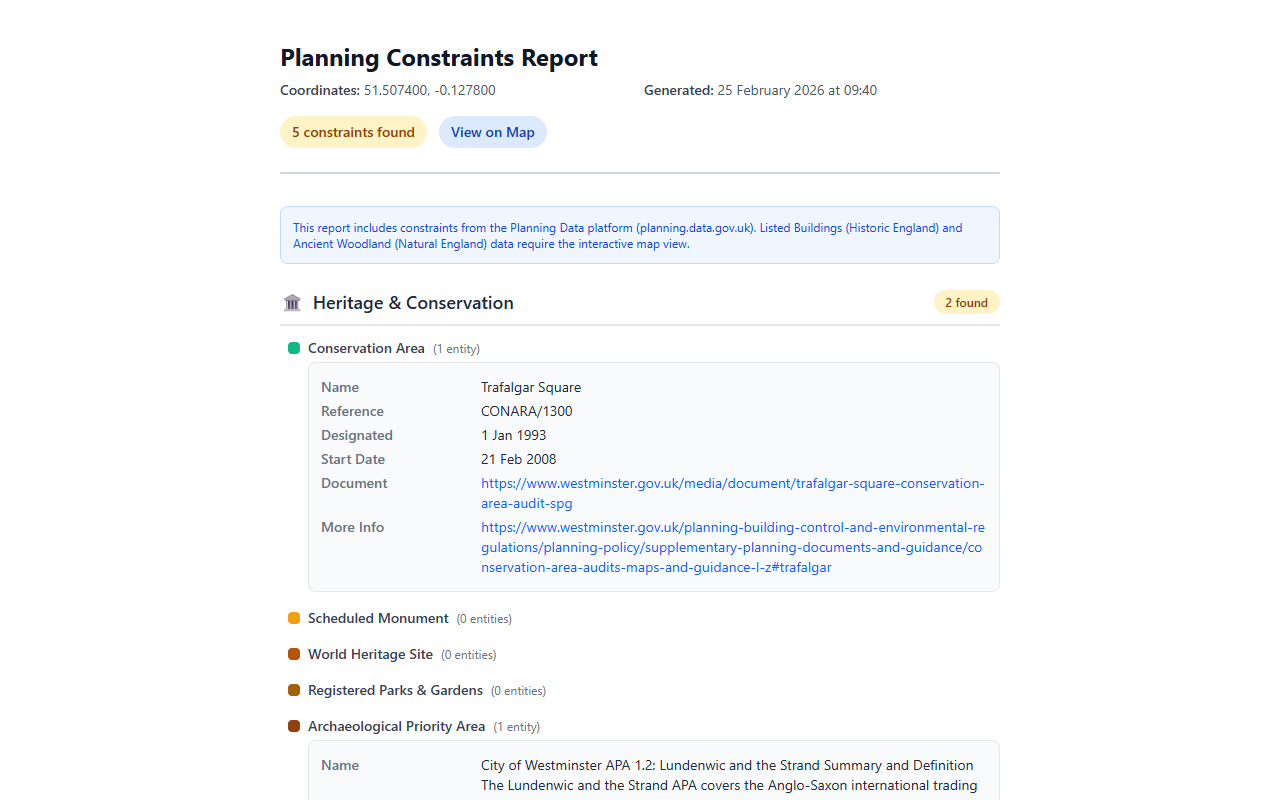
A detailed Planning Constraints Report from PlanningConstraints.com — useful to share with your architect or planning consultant.
Check before you plan
The worst time to discover a planning constraint is after you have paid for architectural drawings. A 30-second check on PlanningConstraints.com can save you thousands in wasted professional fees and months of delay.
Enter your postcode, review the results, and if any constraints apply, discuss them with your architect or a planning consultant before you finalise your design.
Survey your own site — free
Screen any address in England, Wales or Scotland in seconds: conservation areas, listed buildings, flood risk, Article 4 and 129 more. Need it on paper? The Full Survey Report with plain-English guidance is £9.99.